
Environment
How Tanjung Kepah is Bringing Back its Vanishing Coast—and Its Mangroves
A coastal village reverses decades of erosion through science, community involvement, and sustained restoration.
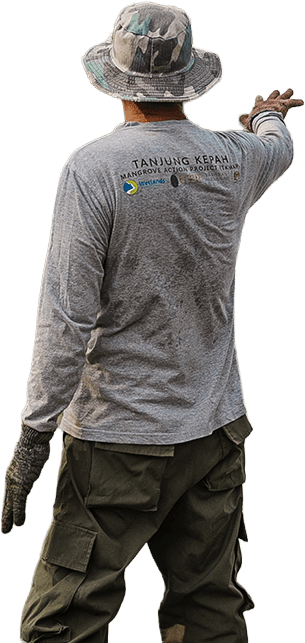
It is mid-morning on a January day. Along the shoreline of Tanjung Kepah, a coastal village just south of Setiawan in Perak, Jamil Bakar Mokhtar, 62, is at work.
The tide has just retreated enough to reveal a wide stretch of mudflat. The air is heavy with the smell of earthy brine. The surface, slick and soft underfoot, is pocked with clusters of tiny holes that mark the burrows of clams and crabs beneath the mud.
Here, roughly 70 metres from the shoreline, stands a fence-like structure built from simple, natural materials: two rows of bamboo poles, with bundles of smaller branches secured within a mesh screen, and sandbags placed along the top to hold the structure in place.
It stretches 25 metres along the shore, stands two metres tall, runs a metre wide, and embedded four metres underground.
The growing presence of visitors is beginning to reshape the rhythm of life in Tanjung Kepah.
Abu Bakar Mokhtar, known fondly by the community as Pak Jamil, is inspecting and maintaining the structure. Several other villagers of similar age are also doing the same.
Methodically, they scrape barnacles from the bamboo poles, tightening the ropes, making sure everything holds. These small, stubborn growths, if left unchecked, can cause the bamboo to decay much sooner than it should.
Keeping the structure intact is a task the community takes seriously, for it is what holds their hope of rebuilding the coastline as they once knew it, before the erosion. And with it, the chance of restoring the mangrove forest that once thrived here.
Pak Jamil (left) and fellow villagers, especially older members of the community, take a proactive role in mangrove restoration, driven by a sense of responsibility to protect their environment.
The unravelling root
“The shoreline used to extend much further, maybe another 50 to 60 metres outwards,” says Pak Jamil, a retired police officer who has lived most of his life along this coast. “When I was young, I would spend my time fishing in the mangrove forest.”
In Tanjung Kepah, the mangrove forest, made up of salt‑tolerant trees and shrubs, was, and still is, very much a part of everyday life. It offers both livelihood and moments of awe to those who venture into its uniquely rich ecological landscape.
A mangrove forest’s most visually striking feature is undeniably its dense, interlocking networks of arching “prop” roots or thin, pencil-like roots that jut above the surface at low tide.
Beneath the waterline, these roots fork into finer, vein-like laterals, weaving an even denser labyrinth. Part cage, part web, this sprawling network forms a thriving nursery for fish, clams, mussels, crabs, and other marine species on which the villagers have long depended for sustenance and income.
But mangroves’ most consequential role may be the one least visible to the eye.
Abu Bakar Mokhtar, known as Pak Jamil, stands by the permeable wave screen or “skrin ombak telap” that helps protect the shoreline in Tanjung Kepah, Perak.
Under the constant push and pull of coastal waters, mangroves’ complex root systems temper the force of the waves and bind the soil together, whilst trapping sediment and allowing it to settle and build up. This process, over time, does more than resist erosion; it also reinforces the land, leaving the coastline better able to withstand the pressures of extreme weather events, including higher sea levels, stronger storm surges, and more aggressive waves.
The mangrove forest is, by any measure, a formidable coastal defence.
But how did Tanjung Kepah come to lose so much of its shore?
It is a tale of compounding damage. Land-use changes and pollution began to unravel the sediment balance the mangroves depended on. At the same time, the ground beneath them—unstable, with too little substrate for roots to take hold—made it hard for new growth to return. As more than 220 hectares of forest were degraded and their roots lost, erosion set in. Waves, storms and rising seas did the rest, pushing an already fragile system past its tipping point.
Over the past two decades, there had been no shortage of mangrove replanting efforts. Yet many fell short. They were often one-off initiatives, undertaken without a clear understanding of root causes or a long-term plan for sustained recovery. The outcome was a cycle of well-intentioned but short-lived interventions.
That cycle held—until recently.
Building with nature and people
The key is to mimic the mangrove ecosystem and incorporate its natural ecological processes into the solution,” says Yong Huai Mei, a conservationist and project coordinator of the Tanjung Kepah Mangrove Action Project.
An initiative led by Wetlands International Malaysia, what she describes is the “building with nature” design philosophy behind the structure – now standing along the foreshore of Tanjung Kepah, one that Pak Jamil and his peers maintain with care.
Officially known as the permeable wave screen, or “skrin ombak telap” in Malay, the structure is designed to create the stable conditions needed for mangrove seedlings to take root.
“It works by slowing and reducing wave energy,” she says. “Instead of completely blocking the waves, it allows some energy to pass through while reducing its impact. At the same time, it enables suspended sediment to settle behind the structure. This process helps stabilise the coastline at Tanjung Kepah.”
Achieving that stability, she notes, is precisely what many earlier replanting efforts lacked. Where attempts were made, they often relied on hard infrastructure that blocked waves entirely and redirected their energy elsewhere, causing erosion in other areas, which is an outcome Huai Mei seeks to avoid.
“The mangroves we planted are growing well, with more leaves, and we are still planting more.”
Abu Bakar Mokhtar ( Pak Jamil )
Community Member of Tanjung Kepah, Perak
The ropes that hold the structure together are regularly maintained and tightened to keep it secure against the rise and fall of the tides.
Local participation is central to the mangrove restoration project. Pak Jamil (left) and Huai Mei (right) tend mangrove seedlings in the nursery.
The permeable wave screen was built in 2024 through a collaborative effort involving Universiti Teknologi PETRONAS (UTP), Wetlands International Malaysia, and local groups like Pertubuhan Sahabat Hutan Bakau Lekir.
“Currently, around 21 local community members are involved in monitoring and maintenance work,” Huai Mei explains, emphasising the importance of local participation from the outset.
Before implementation, the project team spent time with the community. Engagement sessions were held to introduce the initiative, hear concerns and gather input to build early ownership.
Residents were introduced to the science of mangrove ecosystems and the function of the wave screen and given hands-on instruction in planting techniques, seed sowing, and seedling selection.
“Community involvement is critical,” Huai Mei adds. As they observe environmental improvements themselves, they move from being passive beneficiaries to active stewards. They develop a sense of ownership and responsibility towards the project and its long-term success.”
Designed with a “building with nature” approach, the “skrin ombak telap” mimics mangrove ecosystems, stabilising the coastline and allowing seedlings to take root.
The happy returns
“I am grateful, alhamdulillah, that the condition at Tanjung Kepah is improving,” Pak Jamil says. “The mangroves we planted are growing well, with more leaves, and we are still planting more.”
Since the permeable wave screen was installed, Huai Mei and her team have been tracking its impact through a series of studies. The results have been encouraging.
Bathymetric surveys show that seabed elevation has increased, indicating successful sediment deposition. Wave measurements recorded reductions of up to 58 per cent in wave height. Most notably, the survival rate of planted mangrove seedlings has risen from near zero to almost 70 per cent.
“These are strong indicators that the coastline is gradually stabilising,” says Huai Mei.
The signs of recovery have not gone unnoticed by the community.
Short, jagged stumps-remnants of mangrove trees that once thrived here.