
Arts & Public Spaces
An Unlikely Place for Keringkam
Inside a youth detention centre, a heritage craft is shaping discipline, identity, and second chances.
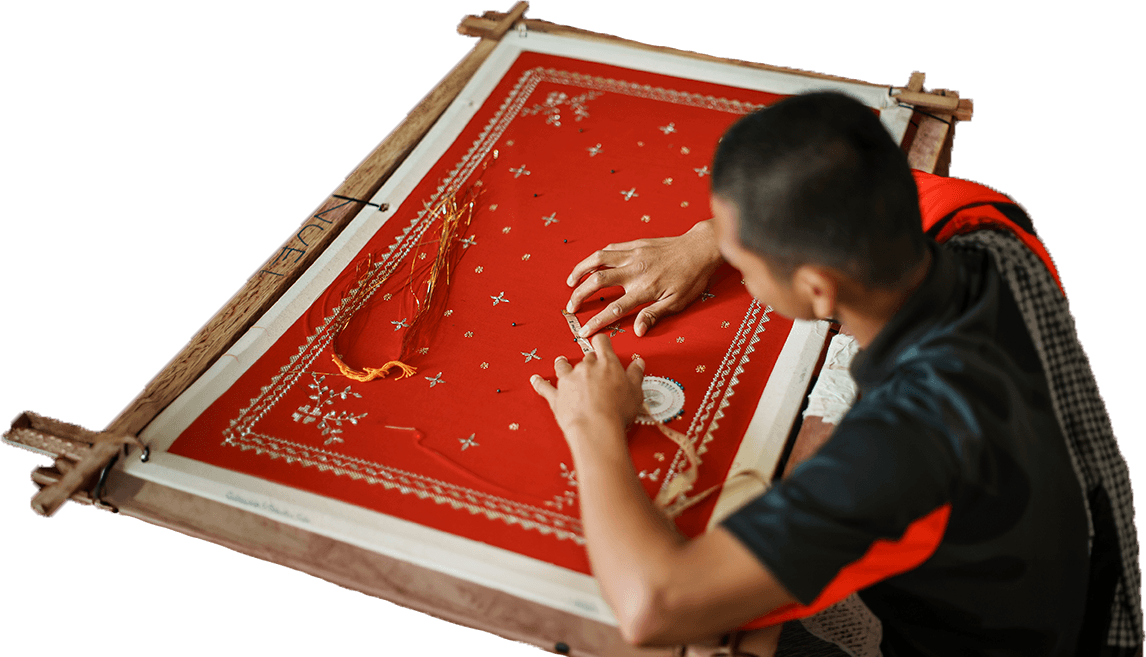
Inside a classroom at Sekolah Henry Gurney in Sarawak, Nazhan (name changed), nearly 21 years old, sits cross-legged on the floor, a length of red gauze stretched taut across a wooden frame before him.
He leans in close, following the weave of the fabric, and counts under his breath. Five strands to the left. Five to the right. If he miscounts, the star motif he is embroidering will distort and the symmetry will break.
He then guides the gold thread through at a slight angle, careful not to pull it too tight. Too much tension, and it will snap.
This is Keringkam, a centuries-old embroidered headscarf or veil once worn by Malay women in Sarawak at weddings and festivals, now practised here, inside a correctional institution.
In a school for incarcerated youth like Sekolah Henry Gurney, measured by recidivism rates and job placements, the decision to teach a nearly extinct form of embroidery appears counterintuitive. Why not coding, automotive repair, or welding? Is this the best use of their time before they face the world again?
In the heart of Kuching city, Brooke Museums offers a glimpse into the past and the resurgence of Keringkam.
A legacy on the brink
For generations, Keringkam has occupied a quiet but revered place in Sarawak’s cultural life. “What makes it special is its technique. It is highly mathematical in nature. Over time, Sarawak embroiderers refined and perfected it into something distinctly their own,” says Liza Sideni, Head of Museums and Education at Brooke Museums.
“About ten years ago, we realised it was crucial to preserve this art form. At that time, it was on the brink of extinction. There were only 26 embroiderers left, and only one was under the age of 30. We felt that if nothing was done, Keringkam would have no future. It was considered an endangered skill, and we knew we needed to find young embroiderers to carry it forward.”
When Brooke Museums began searching for new craftsmen, the solution emerged from an unexpected place: Sekolah Henry Gurney Puncak Borneo.
For the School’s Unit Head and Principal, Tuan Norjayadi Sarkawi, the proposal did not strike him as performative or misplaced. It aligned with what he believes rehabilitation is meant to do.
Liza and her team at the Brooke Museums.
For generations, keringkam has held a revered place in Sarawak’s cultural and sartorial life.
What is passed within
To Tuan Nor, Keringkam’s value lies not merely in the outward mastery of precision and symmetry but in what it cultivates internally.
The thread counting and repetition steady the mind. A miscalculation requires starting over.
Over time, the boys learn to regulate their emotions, to sit with frustration, to correct themselves without being corrected.
“Some students say they value the programme deeply. At first, they resist. Some may even resent me. Imagine strong, well-built boys, looking like soldiers or commandos, suddenly asked to do embroidery. Their ego resists. But we help them lower that ego.”
“When I started, it was very difficult,” Nazhan says.
He entered Sekolah Henry Gurney at 17. He is one of more than 650 youths undergoing rehabilitation across Malaysia’s four Henry Gurney Schools, which serve offenders aged 14 to 21, offering custodial supervision with academic study and vocational training.
“Keringkam requires confidence,” he says. “If you don’t have confidence, you cannot make it beautiful.”
He has been learning the craft for nearly two years. The rose motif remains the most challenging for him. “The technique for making a rose demands patience and creativity,” Nazhan explains, “especially at the beginning, when you are still learning.”
What once felt impossible has settled into rhythm. The counting is steadier now; his hands no longer rush. “When I work on Keringkam, I feel calmer,” he says. “It helps me release stress. I also learn something new.”
Though Sekolah Henry Gurney operates under the Malaysian Prison Department, it remains fundamentally a school, focused on education, protection and rehabilitation.
Confinement and continuity
What many outside do not realise, Tuan Nor says, is that although Sekolah Henry Gurney operates under the supervision of the Malaysian Prison Department, it remains fundamentally a school.
The boys are not treated like adult prisoners. They attend academic classes. They sit for the SPM examination. The mandate is not merely custody, but protection and rehabilitation.
“We shield them from harmful influences,” he says. “We educate and nurture them before returning them to society.
The Keringkam programme was designed with that return in mind. Beyond embroidery, trainees are introduced to entrepreneurial skills and the basics of textile conservation.
Students are brought beyond the School’s walls for museum visits and workshops, where they meet master embroiderers, researchers, and entrepreneurs.
As Liza explains, in some sessions, textile conservators work alongside the boys, guiding them through preservation techniques. In another, the focus shifted to enterprise: if you were to pursue this craft, what would you build? How would you market it?
There is a tangible bridge between confinement and the world outside.
The programme, aptly named ASPIRE, is supported by the Hasanah Special Grant, a funding programme by Yayasan Hasanah.
Over the past two years, the grant has funded essential materials for Keringkam training sessions and enabled workshops both within the school and beyond its gates.
Of the 50 initial participants, over 40 completed the programme. 34 received full certification. Some joined the military or applied to university. Some have gone on to do internships with the museum. Two from the first cohort now work actively as embroiderers.
Carrying it forward
Amran, now 23, is among those who remained with the craft after his release from Sekolah Henry Gurney.
He now works at the Brooke Museums, where he spends hours stitching metallic thread into gauze with the measured steadiness the craft demands.
His salary is modest. “It’s enough for me,” he says.
“Enough to buy what I need. Slowly, we save.”
A man of few words, Amran has become one of the museum’s most accomplished Keringkam embroiderers, his work indistinguishable from that of far more seasoned craftsmen.
In five years, he hopes to establish something of his own, perhaps to teach, guiding new students through the same careful discipline that gradually gave shape to his days.
“It teaches us what it’s like to run our own business and also how it feels to work under others.”
Khairul
Participant, Kacik 1998 Food Court
Amran, 23, is a Sarawakian youth artisan practising keringkam, working at the Brooke Museums.
Sekolah Henry Gurney students gather around a sewing machine during a Keringkam training session.
A participant learns to operate a sewing machine as part of the programme skills training.
An inheritance of worth
Nazhan, due to be released in two months, is hopeful about what comes next. He speaks of attending university, finding a lawful job, and practising Keringkam part-time.
His mother, he says, was the happiest when she first learned he was studying the craft. She has asked him to teach her. Perhaps they might open a small business together in the future.
“She wants to see me succeed,” he says. “She does not want me to return to my old ways.”
“We all make mistakes,” says Tuan Nor. “So, give them space and opportunity. These children often make mistakes not purely out of personal intent. Sometimes it is peer influence, curiosity, and the impulsiveness of youth. But when the choice is wrong, they are sent here. Our role is to educate and to return them to society.”
“Before, people discarded them like shards of glass. But when they master a skill and gain discipline, people begin to see them as diamonds. Once cast aside, now refined through embroidery, skill-building, and structure, they become something of value.”
“For Yayasan Hasanah, the project was never solely about preservation,” says Momoko Sum, Programme Manager for the Foundation’s Arts and Public Spaces pillar.
“The initiative brings together two priorities we care deeply about: safeguarding traditional art forms and supporting vulnerable communities—in this case, the students of Sekolah Henry Gurney.”
Heritage textile craft is more than fabric; it carries the memory and identity of a people.
To practise it is to step into that inheritance.
In that sense, art is not merely something to be admired. It is a discipline that connects people — past, present and future — within a shared cultural continuum; and in doing so, offers a renewed sense of belonging, purpose and value.
An exhibition of Keringkam and the ASPIRE programme at Brooke Museums.