
Education
They Come for Football. Learning Comes with It.
In Tawau, football is bringing children back into classrooms—and making them want to stay.
On a late Tuesday afternoon, Rusdianto stands at the edge of a football field in Tawau, a small town on Sabah’s far eastern coast. The sun hangs low behind a bank of clouds. The rain has passed, but the grass remains slick.
His gaze is fixed on the pitch.
His nine-year-old son, Aqil, is playing goalkeeper today. Knees bent, arms slightly outstretched, Aqil shifts from foot to foot, tracking the ball as his friends from opposing teams press back and forth across the field in search of a goal.
Their technique is not yet polished, but their determination is unmistakable. Passes misfire, feet tangle, shots drift wide. Still, they regroup and try again.
Three professional coaches move along the sideline, calling out encouragement, repositioning players, and demonstrating footwork with steady patience.
Football is the children’s favourite game here; the town has a network of grassroots training centres to match.
But for Rusdianto, like many parents who send their children to the field, football is not quite the end goal.
Julazman Jupril (left), leads the sessions on the pitch, emphasising the development of discipline and a spirit of camaraderie.
The goal beyond the goalpost
“We don’t want these children to excel only in football. We want them to succeed academically and attend school consistently,” says Rahman Imuda, founder of the CELIK programme.
CELIK is Rahman’s initiative, aimed at encouraging primary school children aged seven to 12 to stay engaged with learning. The method, however, is less expected. The programme uses football as a bridge, something the children genuinely enjoy and the reason they keep showing up.
Rahman is a certified football coach. Before starting CELIK, he coached at local football academy, Akademi Bola Sepak TawauKini, where conversations with parents often revealed a shared concern: their children’s lack of interest in school.
“When we conduct football training sessions, parents often tell us that their children are very diligent about attending practice,” he recalls. “But when it comes to going to school, they tend to be less motivated.”
Many of the students who enrol in the programme, he explains, are academically behind; most come from low-income families.
In Malaysia, students’ learning progress is measured through Tahap Penguasaan (TP), or Levels of Mastery,a six-tier scale used to assess achievement in each subject.
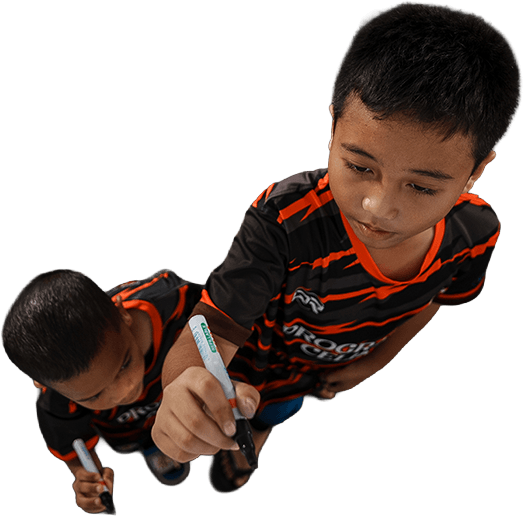
Nine-year-old Aqil, once withdrawn, now engages with peers, playing and socialising more comfortably, and looks forward to classes and football sessions.
Amongst students in the CELIK programme, many sit at TP1 or TP2, the lowest levels of mastery, with only a few at TP3. They also miss school frequently and are increasingly disconnected from the classroom.
Born and raised in the town, Rahman understands how easily early disengagement from school can turn into long-term absence.
Across Sabah, dropout rates rise between the ages of 10 and 14 (4.2 per cent) and increase further after 15 (26 per cent), higher than national averages.
The reasons are often complex, spanning a myriad of socioeconomic circumstances and, at times, geographical barriers. But for many low-income families, parents are simply stretched thin. Long working hours leave little time to supervise homework or stay closely involved in their children’s studies.
Rusdianto recognises this challenge in his own household.
“Previously, like many children today, my son spent a lot of time on his smartphone,” he says. “As working parents, we sometimes don’t have enough time, and children naturally turn to their devices.”
CELIK was designed to step in at precisely this stage, offering more structured after-school learning support before early disinterest in learning begins to take hold.
“Even before starting the programme, we understood that most of the children joined because they wanted to play football, not necessarily to attend classes. We accepted that reality,” Rahman says.
So instead of forcing enthusiasm for lessons, Rahman and his team worked with teachers to reshape the classroom experience. CELIK’s tuition classes were curated to be more interactive and less rigid, with activities that break up long stretches of sitting and give children more room to participate rather than simply endure.
Literacy classes build vocabulary and comprehension in Bahasa Malaysia, encouraging children to read aloud, form sentences, and make sense of what they see on the page. Numeracy lessons focus on basic calculations, patterns, and simple problem-solving.
Anyone who has ever struggled to sit still in a classroom knows that learning requires sustained focus and discipline.
Here, the day does not end when the books close.
Outside the tuition centre, a bus waits. When lessons wrap up in the late afternoon, the children spill out, trading exercise books for football boots. They climb aboard, energy shifting, anticipation building. Minutes later, they are on the field.
The structure is deliberate: learning comes first, football follows.
In this rhythm: from classroom to field, from focus to the freedom of play; football becomes more than an incentive. It becomes the bridge that keeps them coming back to learn.
Learning comes first: CELIK makes a deliberate effort to create an engaging classroom experience.
Lessons from the field
“No matter how talented you are, without discipline you will not go far.” This is a message CELIK students often hear from their football coach.
Julazman Jupril, known to the children as Coach Mang, leads the sessions on the pitch. A certified football coach, he also works alongside Rahman at Akademi Bola Sepak TawauKini.
Rahman jokes that Coach Mang is the children’s favourite because his sessions are the “fun” ones.
He has a gentle face and an easy smile, but there is firmness in the way he carries himself. When he calls for attention, his voice cuts through the chatter, and the children respond immediately.
In the early weeks of the programme, he recalls, the children’s energy was abundant; their self-control less so. Enthusiasm often spilled into friction. A missed pass could trigger blame. A hard tackle might end in sulking.
When these moments arise, Coach Mang treats them as opportunities to teach. Conflicts, he reminds the children, are part of the game, just as they are part of life.
“What matters is how you resolve it,” he says. He encourages them to listen, apologise, shake hands, and move forward.
Before long, they are laughing again, the tension dissolving back into play.
Through CELIK, the same group of students spend hours together each week; studying, training, and playing side by side. Gradually, friendships form and a sense of camaraderie takes root.
“What makes me happiest is seeing them play as a team,” Coach Mang says.
The CELIK programme currently supports 80 students across two age groups: 7-9 and 10-12.
CELIK students gather as the lesson ends, energised and ready for football.
A child finding a new rhythm
At home, Rusdianto sees the change in his son clearly, even in small, everyday moments.
Before joining the programme nine months ago, his son’s afternoons were unstructured. Time slipped easily into hours on a smartphone, and he rarely played with others.
Rusdianto worried that his son might become too withdrawn.
“After joining the programme, he began engaging with peers; playing together, communicating, and socialising more comfortably,” he explains.
Aqil is now eager to attend both classes and football sessions. He knows his schedule better than his father does.
“Sometimes I forget,” Rusdianto says with a laugh. “He reminds me, ‘I have tuition today at 1pm’, or, ‘Today is training’.”
Tuesday is class and football. Saturday is class. Sunday is training.
The weekly rhythm has settled into Aqil.
“That level of discipline is very obvious,” Rusdianto says. “Academically, I can also see improvement.”
Rahman Imuda (centre), founder of the CELIK programme and certified football coach.
The road ahead
Rahman has observed similar academic progress across the cohort of 80 students aged seven to 12.
Their school attendance, which once hovered around 70 or 75 per cent, now approaches 90 per cent. Students at the lowest mastery levels are steadily improvingfrom TP1 to TP2, and from TP2 to TP3.
While academic progress remains the programme’s priority, Rahman says he has also been encouraged by improvements in the children’s social skills.
“We believe education must be holistic. It should not only develop the mind, but also build character,” says Chow Shenn Kuan, Senior Manager of Advocacy for the Education Pillar at Yayasan Hasanah.
The foundation, together with the Ministry of Finance Malaysia, supports the CELIK programme through the Hasanah Special Grant, drawn to the programme’s unique approach of channelling children’s love for football into a commitment to learning.
“The effort to educate must be grounded in the realities of children’s lives. We meet them where they are,” Shenn adds.
For Yayasan Hasanah, meeting children where they are means recognising their interests and finding ways for those interests to intersect with learning.
These small gains in the early years on the ability to read, to reason, to express themselves, and to connect with others can widen the road ahead, keeping possibilities open that might otherwise close too soon.
“After joining the programme, my son began engaging with peers, playing together, communicating, and socialising more comfortably.”
Rusdianto
Parent of a participant in the CELIK programme
CELIK focuses on building literacy and numeracy skills.
CELIK students gather as the lesson ends, energised and ready for football.