
A Doctor, Shaped by a Different Idea of Care
Inspired in part by his great-grandfather, a Bidayuh shaman, he chooses to practise medicine with presence, not distance.
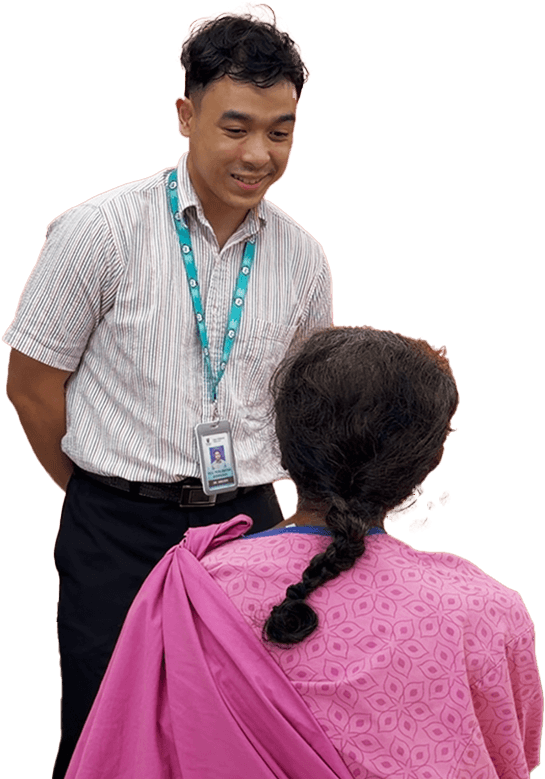
“I’d say I’m a scientific-based shaman working in a hospital,” says 26-year-old doctor-in-training, Abiezer Shannio Anak Abeng, with a smile and a hint of jest.
His great-grandfather was a lead shaman in a Bidayuh village in Sarawak. The shaman was a figure the community turned to for healing, and sometimes for reassurance and meaning when something in life had gone wrong.
His great-grandfather’s world, for Abiezer, is not tangential to his own medical career, as many might expect, but part of an enduring continuum of the concept of care.
Across generations, many in his family have gone on to pursue careers in modern medicine. In that sense, his aspiration to become a doctor was not unexpected.
What kind of doctor he becomes, however, is entirely his own story to write.
Abiezer, now 26, works as a house officer at the University Malaya Medical Centre in Kuala Lumpur.
Becoming a doctor
Dr Abiezer currently works as a house officer at the University Malaya Medical Centre in Kuala Lumpur, Malaysia.
The demands of hospital life are relentless. Most days, he arrives before dawn and works through a torrent of responsibilities: patient reviews, procedures, and administrative coordination. The system, like many healthcare systems around the world, runs on compressed time and sustained endurance.
For Abiezer, the gravity of a doctor’s responsibility became real to him when he began to see the direct impact of his decisions in his patients’ recovery.
“Seeing them go from bed-bound to walking unassisted, and eventually out of the hospital, that’s something I hold close to my heart,” he says.
For Abiezer, the weight of a doctor’s responsibility became real as he began to see how his decisions shaped patients’ recovery.
But not all moments in medicine move towards recovery. There are times when patients do not make it, and doctors must deliver the news to family members, to friends, and sometimes to the patients themselves. These are the moments that mark a different kind of reckoning in a doctor’s life. Abiezer acknowledges the weight of witnessing loss, and, sometimes, of absorbing grief that is not his own.
As he gains more experience and rotates through the different facets of medical practice, Dr Abiezer finds himself increasingly drawn to paediatrics. The interest first took root in his third year of medical school, when a posting in the speciality unlocked for him a new perspective on patient care.
In paediatrics, he says, the patient is never just the child. There are parents to reassure, family dynamics to navigate, and, importantly, a longer horizon to consider, as each medical decision carries implications for a life still unfolding.
Abiezer earned the Khazanah Watan Scholarship on his second attempt, after a year spent growing through leadership experience and extracurricular work.
Life outside the hospital
Dr Abiezer’s passion for paediatric care extends well beyond the hospital walls.
He is involved with “Monsters Among Us”, a non-profit organisation focused on combating systemic violence against children in Malaysia.
Much of his work takes place in schools and children’s homes, where he delivers comprehensive sexual health education, which is a subject that, he says, many would rather sidestep.
For him, that discomfort marks precisely where the work is needed most, particularly in a context where one in every 10 children in the country is a victim of sexual abuse at the hands of someone they know.
His work in advocacy also extends to HIV and AIDS awareness, where he has taken a more unconventional approach. In collaboration with his university, he helped develop a musical aimed at raising awareness about HIV and AIDS, challenging lingering stigma through performing arts.
The medium as not unfamiliar to him, having grown up immersed in music and dance and being a violinist and occasional singer himself.
“I came up with the idea and saw it through to a fully realised project. That’s something I’d love to do again,” he says.
Beyond the hospital, Abiezer is involved in advocacy work, addressing systemic violence against children and raising awareness of HIV and AIDS.
Internalising compassionate care
Abiezer sees his work in the hospital and the community not as separate worlds but as a seamless extension of one another. It deepens his capacity for compassion.
In the hospital, the focus is necessarily clinical. The work is structured and precise.
His community work, on the other hand, teaches him that care also requires presence. It is about offering time, listening, and a sense of reassurance in moments that can feel uncertain or overwhelming.
Given that much of a doctor’s work is spent caring for people they have never met before, coupled with the pace of hospital life, one can easily become detached, whether through indifference or exhaustion.
Abiezer recognises this tendency in others and is deliberate in resisting it. If anything, he leans further in.
“Taking what I learn outside the hospital back into it has taught me not to see patients as just illnesses, but as people with lives, people who need more than medicine or surgery, but a more holistic kind of care,” he says.
“Whenever I see a patient, I want to ensure that, despite the pain they’re going through and the days they have, they still feel there’s someone who really cares. I want to give that sense of hope to my patients.”
Looking ahead, Abiezer’s aspiration extends beyond individual practice to the broader advancement of healthcare in Malaysia.
“I want to be a better doctor,” he expresses. “Not just for my patients, but for the people I work with. And for the system.”
At the same time, he hopes to remain engaged in research, contributing to the search for better treatments and more effective ways of helping patients heal.
“Taking what I learn outside the hospital back into it has taught me not to see patients as just illnesses, but as people with lives, people who need more than medicine or surgery, but a more holistic kind of care.”
Abiezer Shannio Anak Abeng,
Khazanah Watan Scholar, 2019
Scholarly resilience
Abiezer was awarded the Khazanah Watan Scholarship in 2019 to pursue medicine at Universiti Malaya.
It was his second attempt. The first time, he fell short. But the setback did not deter him. He used the year to grow, taking on leadership roles and immersing himself in extracurricular work during his foundation studies.
“All in all, Abiezer represents the type of Khazanah Watan Scholar we aspire to develop: individuals who are professionally capable, socially conscious, and driven by purpose, ready to contribute meaningfully to Malaysian institutions and society,” says Siti Salwani Binti Rosdi, Senior Executive of Talent Development at Yayasan Khazanah Scholarship.
“Khazanah Watan gave me opportunities I might not have had otherwise,” he says. “It helped shape who I am today, and how I want to contribute.”
For him, being a doctor is not only about treating illness, but about recognising the life that surrounds it — and caring for both.
“Khazanah Watan gave me opportunities I might not have had otherwise. It helped shape who I am today, and how I want to contribute.”
Abiezer Shannio Anak Abeng,
Khazanah Watan Scholar, 2019
Abiezer earned the Khazanah Watan Scholarship on his second attempt, after a year spent growing through leadership experience and extracurricular work.