
Community Development
This Food Court in Kuantan Proves that Trust can be Rebuilt
A working food court is quietly reshaping what recovery and reintegration can look like.
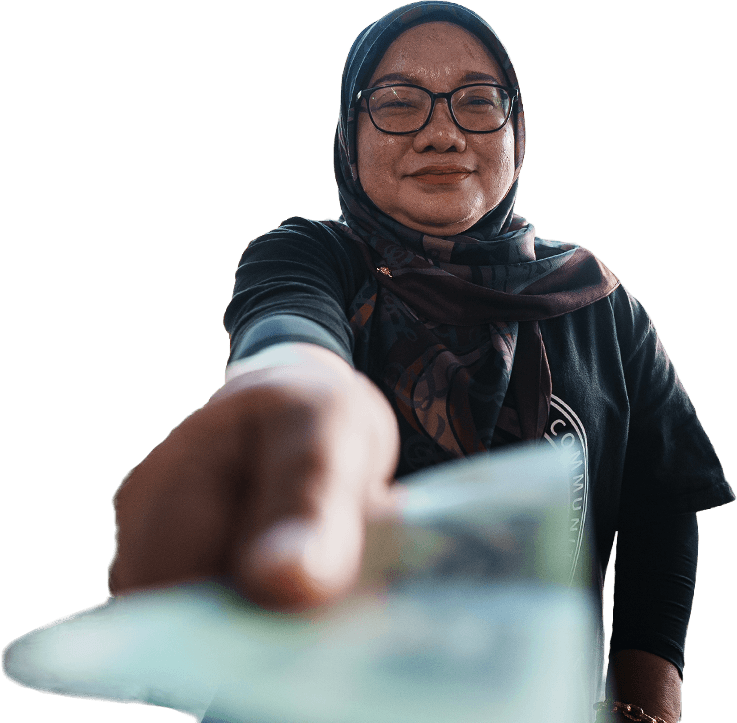
In the late afternoon, under the low hum of ceiling fans and the lingering heat of the day, 52-year-old Lea Rosnani Awang works behind the cashier’s counter at Kacik 1998 Food Court.
The place typically opens at 2pm. By now, it has settled into its rhythm.
Located in Kuantan, Pahang, the food court is neither large nor small, but rather diverse in its offerings. Seven stalls line the space. There are rojak, nasi lemak, cockles, curry noodles, western plates, fried kuey teow, and burgers.
The crowd that comes through is mostly from the hospital next door: doctors and nurses on their breaks, security guards grabbing a quick meal, people passing through on their way to or from a visit.
Lea, known here as Kak Lea, works as a cashier, but she also runs the place. She moves between stalls when she is needed, keeps an eye on things, and steps in to lend a hand when required.
She is capable and trusted with the overall management of the food court, from handling the day’s takings to overseeing its daily operations.
But this was not always her life. More than a decade ago, her days were starkly different, spent mostly oscillating between euphoria and hopelessness.
The food court has seven stalls serving rojak, nasi lemak, cockles, curry noodles, Western plates, fried kuey teow and burgers.
The bitter years
“In the past, I was a hardcore drug addict. I was in and out of prison and rehabilitation centres, and I lived as a homeless person,” says Kak Lea.
At the time, Kak Lea had two young children. Her repeated arrests meant that she would eventually lose custody of them, and they were placed under the care of the Social Welfare Department.
It was that loss, more than anything, that forced a reckoning. “Was I really going to destroy my life and my children’s lives?” she recalls asking herself.
For their sake, she was determined to look for a way out. And she found it at Komited Malaysia, a drug-use intervention and HIV prevention organisation led largely by people who had walked the same road.
She admitted herself into a women’s rehabilitation centre run by the organisation, where she began her recovery.
Kak Lea has lived drug-free since 2011. Yet, her journey back to society is still unfolding.
Known here as Kak Lia, is one of the participants who works as a cashier and oversees the food court’s day-to-day operations.
Operating a food stall offers people in recovery, like Khairul, a chance to restore confidence and a sense of independence.
Locked out of society
“God is truly great. He saved me for a reason, to help others so they do not have to go through what we went through,” says Khalid Hashim, Komited Malaysia’s Founder and President.
The greatest obstacle for individuals overcoming substance abuse is not the addiction itself but the way it is seen, Khalid says, speaking from his close to three decades of rehabilitation work.
Drug users, some also living with HIV, are often reduced to a narrow set of labels: useless, criminal, incapable of contributing. These labels go on to shape how they are treated by society and, eventually, how they see themselves.
Even when individuals are ready to rebuild their lives, the path forward is unclear. Employment is difficult to secure as societal trust is slow to return, if at all.
Existing laws, Khalid opines, do little to ease that transition. Without a viable way back into ordinary life, many find themselves circling the same conditions they had tried to leave behind.
Khalid Hashim, Komited Malaysia’s Founder and President.
A second helping
The Kacik 1998 Food Court, for Komited Malaysia, is a means of breaking that cycle.
“Many of those in recovery are drawn to work that offers stability, jobs that come with shelter, food, and a daily structure they can rely on,” he says.
It was this understanding that led his team to develop a social reintegration programme centred on the food industry, where such elements are inherently part of the work.
Before being placed in the food court, participants went through a certified two-month training programme in food preparation. And from a larger pool of candidates, 40 individuals were selected for the programme.
At the Kacik 1998 Food Court, the routines of work take on added significance in building discipline. Each individual, working in groups, manages a stall from start to finish, from sourcing ingredients to preparing and serving meals. Standards of cleanliness and timeliness are strictly upheld.
Just as importantly, the environment places participants in everyday interaction with the public, allowing them to work alongside others without the distance that stigma often creates.
For the public, regular patronage by medical professionals working in the nearby hospital lends an added layer of confidence. Gradually, people began to reassess their assumptions. And when they see a clean and professionally run food court, what they once feared comes to look a great deal like the ordinary.
“This programme has far exceeded my expectations,” says Khalid. “Even established restaurant owners are now recruiting from it.”
One year in, ten job placements have been secured through the Kacik 1998 Food Court programme.
Khalid hopes the programme will continue, as many in the community remain in need of support.
The sweetness of an ordinary life
Amongst the participants working at the Kacik 1998 Food Court is Khairul, who runs the burger stall.
Now in his 40s, he is experiencing, for the first time in his life, a semblance of normalcy.
For nearly a decade, substance use kept him in and out of prison, where little changed beyond the passage of time.
“Inside prison, everyone was the same. No one talked about change. No one,” he says. The system, he adds, did little to challenge that mindset.
“Outside, it felt worse,” Khairul recalls. Prison rehabilitation, by his own account, gave him back his health but offered little direction for what came next.
“I tried to find work, but no one would hire me. I would fill up forms and wait. Nothing,” he says. Upon release from prison, the structure disappeared, and he would immediately fall back to his old ways.
The environment at Komited Malaysia, he found, was different.
“It teaches us what it’s like to run our own business and also how it feels to work under others.”
Khairul
Participant, Kacik 1998 Food Court
The burger stall at Kacik 1998 Food Court ran by the programme participants.
It was not rigid or punitive, but warm and accommodating. There was food, routine, and small allowances for daily tasks. What mattered more was the people. Many of the staff had once been in similar positions.
“If they can do it,” he thought, “why can’t I?”
At the food court, he has learned to work within structure: how to manage time, handle money, prepare food, and maintain a routine. “It teaches us what it’s like to run our own business and also how it feels to work under others.”
He hopes, eventually, to open a burger stall with a few others. For now, he acknowledges that he still has more to learn, more confidence to build.
Importantly, Khairul is on the mend and can look forward to the possibility of a different life.
On the other side of the food court, Kak Lea represents what successful rehabilitation can look like. In the years since her recovery, she has been reunited with her children, who are now 21 and 18. She has rebuilt a life that now carries a sense of independence.
Kak Lea, for more than a decade, has also been a critical pillar of the community, supporting those still in recovery and helping others rebuild their lives.
Now, with culinary and business management skills behind her, she is thinking about starting a nasi lemak business of her own.
A food industry-based reintegration programme offers people in recovery a balance of stability and a chance for connection with others.
A shared return
For Yayasan Hasanah, whose mission is to uplift marginalised communities through lasting economic participation, it is exactly the kind of work worth investing in.
The programme is supported through the Hasanah Special Grant, managed by Yayasan Hasanah in collaboration with the Ministry of Finance, Malaysia. The funding enables the operation of the food court, as well as the broader ecosystem of training, support, and aftercare that underpins it.
The Kacik 1998 Food Court has redefined how social reintegration is conceived.
Using food as a bridge is ingenious, but no simple feat; it demands diligence from those behind the stalls and trust from the public.
Reintegration, after all, is not only the burden of those trying to return. It depends just as much on whether society is willing to embrace them.
Here, in this food court, both are at work.
Rosnani Awang (Kak Lia), 52, drug-free since 2011, is one of 40 participants in the Kacik 1998 Food Court programme.