

Social Enterprise
‘Keruing Neram’: What these Trees Hold Together
A single tree species is revealing how ecosystems, livelihoods, and communities are more connected than they seem.
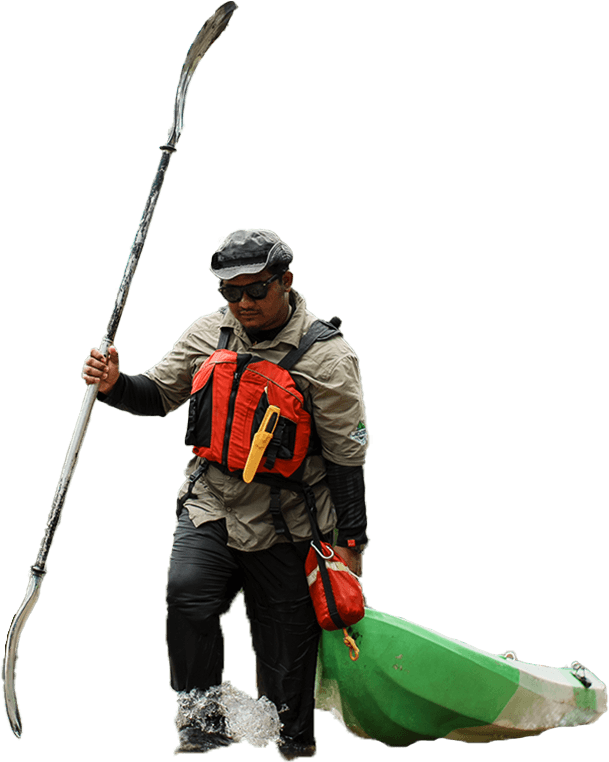
On a morning in late March, Sungai Berang flows steadily and calmly through the hilly, forested interior of Terengganu, Malaysia. A handful of kayakers spread out across the river. Their boats, in shades of neon green and yellow, are striking against the earthy contours of the brown-green current.
Some paddle in an easy rhythm, their strokes measured and confident. A few are in kayaks for the first time, their paddles swinging too wide, too clumsily, occasionally sending their boats into helpless spins that draw laughter from the group.
These are visitors who have come to escape the hustle and bustle of Kuala Lumpur, hoping to spend a day immersed in nature in the tropical rainforest.
Accompanying them are two rangers. Leading the group today is Najmi, who grew up on the river and knows its currents and bends and the rise and fall of its flow.
At this time of year, the water level is low enough to reveal the sandy and gravelly riverbanks.
Lining the banks are giant trees, with their massive trunks leaning towards the river.
Sungai Berang originates in the hilly, forested interior of Hulu Terengganu and flows into Sungai Terengganu at Kuala Berang, forming part of the region’s waterway network.
Their branches spread across to form a vast emerald canopy. Beneath it, the harsh glare of the tropical sun breaks into scattered coins of gold, flickering on the river’s surface. The air feels noticeably cooler.
But not every stretch of the river looks like this.
At times, Najmi reminds the group to steer their kayaks carefully to avoid fallen trunks and branches half submerged in the water. In other places, the canopy thins and disappears entirely. Sunlight beats down on the river and exposed banks where the green vegetation has given way to bare, brown earth.
Here, the river feels different. It is hotter, harsher, and more exposed.
“Since 2019, we’ve started noticing the river getting wider,” says Najmi. “This happens because the trees are no longer there.”
It is a change he now speaks about often — not just to visitors, but within the community itself.
The loss of trees along the river has been gradual, but it is becoming harder to ignore. And without intervention, these small shifts could eventually develop into something far more damaging along Sungai Berang.
The threat of the disappearing tree
The trees Najmi is referring to are known locally as Keruing Neram.
Native to riverbanks in Peninsular Malaysia and parts of Borneo, these towering hardwoods can reach up to 40 metres in height.
In Sungai Berang, their broad canopy above the river provides shelter for gibbons, several species of monkeys, including long-tailed macaques, and birds like hornbills, eagles and kingfishers. Lower down, natural cavities in the trunk sometimes house colonies of kelulut, or stingless bees.
The seed of the Keruing Neram often captivates visitors, Najmi explains, and is most recognisable for its distinctive winged form. The small, nut-like seed is surrounded by five light- to reddish-brown elongated wings: two long wings, often reaching 15–25 cm, and three shorter ones.
As it falls from the canopy, the wings catch the air and spin like a helicopter before landing on the water. Carried by the current, some fruits eventually settle along the banks and take root.
Others become food for a variety of freshwater fish below the surface, including baung, sebarau, kelah, kaloi, and others which the villagers nearby have relied on for both food and income for generations.
Yet, the tree’s most important role lies underground.
Najib (second from right) and his team of Neram Rangers: Najmi (second from left, Aizat) (far right) and a trainee.
Keruing Neram’s roots, often spanning several metres, are shallow but wide-spreading. The dense network of lateral roots grips the sandy riverbank soils, holding the earth firmly in place against the currents and seasonal floods brought by the Northeast Monsoon each year between November and February.
“During the monsoon, the river rises significantly, and everything here goes underwater,” says Najmi, pointing to the exposed riverbank. “Without the trees, every year, the bank erodes little by little.”
Najmi, 26, is a certified nature guide with a diploma in tourism management. He has spent most of his 20s accompanying visitors down this river. Having grown up here, he began noticing during this time that the river was not quite the same one he knew from childhood.
In some places, sections of the riverbank have collapsed, allowing the water to spread across a wider channel. Over time, the river grows shallower and flatter, altering the riverine landscape and much of the life that depends on it.
“Upstream, we can already see fish populations starting to decline,” Najmi says. “Fish here need deeper streams to breed, and those breeding grounds are disappearing.”
For years, the loss of Keruing Neram attracted little attention.
For many years, the Keruing Neram was simply part of everyday life — familiar, useful, and rarely questioned. However, their ecological role went largely unnoticed.
Its hardwood was felled for furniture. Honey was harvested by cutting into the hollow trunks where stingless bees nested. Clearing trees along the riverbanks created space for crops.
Individually, these activities are small in scale, ways for villagers to earn a modest living. Cumulatively, and in the long run, they destabilise the entire ecosystem surrounding Sungai Berang and, with it, the village livelihoods—from farming to fishing.
Protecting the trees, however, would require more than environmental awareness.
Keruing neram trees, native to riverbanks in Peninsular Malaysia and parts of Borneo, can reach up to 40 metres in height.
An attempt at renewal
People were cutting the Keruing Neram trees because they needed income. Without another way to earn a living, conservation alone would not be enough to stop it.
It was this realisation that prompted its founder, Najib Alias to change course. Originally from the west coast of Peninsular Malaysia but long settled in Terengganu, he began reshaping his outdoor recreation business, Jenoba, around a larger mission—giving rise to the Neram Rangers project.
“The Neram Rangers are a group of young local guides leading ecotourism activities along Sungai Berang, whilst raising awareness and keeping watch over one of its most valuable tree species, the Keruing Neram,” says Najib.
The idea is to use ecotourism as a way to support conservation while creating new sources of income for the village, starting with its younger generation.
The young people recruited into the Neram Rangers programme are mostly from nearby villages in Sungai Berang. Many are under 30 and come from households with limited economic opportunities.
A visitor plants a Keruing Neram seedling under Najmi’s guidance, a hands-on encounter with Keruing Neram conservation along Sungai Berang.
“We send them for training to develop knowledge and skills in recreation activities and Keruing Neram conservation,” Najib explains. Participants train in kayaking, camping, and jungle trekking, as well as environmental interpretation, or the art of explaining ecosystems to visitors.
One of the trainees, Aizat Ishak, first joined the programme because of his interest in kayaking.
He had studied sport management at college, but before joining Neram Rangers, his income was modest. The work now allows him to earn a little extra while spending time along the river he grew up near.
More importantly, he says, it changed how he sees the landscape around him.
“Before this, I was only interested in kayaking,” he explains. “But after joining Neram Rangers, I started learning about the flora and fauna here.”
The Keruing Neram tree, he adds, is something locals often overlook precisely because it is so familiar. “For us it feels ordinary,” he says. “But when people from outside come here and see it, they get excited.”
Watching outsiders react to Keruing Neram can shift a person’s—and the community’s—perspective; what once seemed unremarkable begins to feel like something worth protecting.
Signs of hope
In Sungai Berang, the early signs of change are modest but tangible.
Awareness of the Keruing Neram tree has begun to grow within the community. Tree cutting has become less frequent.
As visitors arrive for kayaking trips, nearby villages see small economic benefits: food stalls serving local dishes, truck drivers hired to transport tourists, and villagers engaged to cook meals for visitors.
People are starting to recognise that Keruing Neram may hold value not just in what can be taken from it, but in what can be preserved.
“All these positive changes are very meaningful to me, because none of this existed in Sungai Berang before,” Najib says with a smile.
Currently, Najib has one full-time Neram Ranger working with him—Najmi. Two new recruits, including Aizak, are now in training, and more have expressed interest in joining the programme. “Our plan is to have 10 to 15 Neram Rangers in total,” says Najib.
The Neram Rangers initiative is supported by the Hasanah Social Enterprise Fund, which supports social enterprises that aim to create both social and environmental impact. The fund is managed by Yayasan Hasanah in collaboration with the Ministry of Finance, Malaysia.
The Neram Rangers programme draws its recruits from villages near Sungai Berang. They are primarily young people under 30, with priority given to those from low-income households.
For the Foundation, the appeal of the project lies in how it links conservation with economic opportunity.
“It is how their business model is able to generate a form of revenue that goes back to the community and takes care of our ecosystem in Malaysia,” says Wan Qistina Wan Izahan Zameree of the Social Enterprise team at Yayasan Hasanah.
The broader goal, she explains, is to help social enterprises grow into sustainable businesses that can eventually operate independently while continuing to generate impact.
Cycle of life
Now, beyond guiding visitors, Najmi, Aizak and the other Neram Rangers make their way along the same stretches of riverbank two or three times a week, noting where the trees still stand and where they have disappeared. Along the way, they continue speaking with villagers, explaining why the trees matter and how the river depends on them.
Being a Neram Ranger is patient work. But Najib believes it is the kind that lasts.
The lesson, perhaps, lies in the Keruing Neram itself.
Each season, its winged seeds spin down from the canopy and drift along the current, searching for a patch of riverbank where they can take root to begin a new cycle of life.
In much the same way, the village’s youth must also find where they belong — and build a life there. Now, they can do so through work that protects the land they grew up on.
In time, Keruing Neram and the village can grow together.
“Before this, I was only interested in kayaking. But after joining as a Neram Ranger, I started learning more about the flora and fauna here. What once seemed ordinary begins to feel like something worth protecting.”
Aizat Ishak,
Neram Ranger, Jenoba & the Neram Rangers programme
Najib Alias, founder of Jenoba Trading and the Neram Rangers programme, built on the belief that protecting the Keruing Neram trees required giving communities a reason—and a livelihood—to do so.
A Neram Ranger briefs visitors in life jackets and paddles ahead of their kayak excursion on Sungai Berang.
Visitors and Neram Rangers pause on Sungai Berang, framed by the breathtaking canopy of Keruing Neram trees lining both banks.